We tested 10 disposable email services across 50+ websites. Compare success rates, privacy, and find the best temp email for your needs. Updated April 2026.
In 2026, disposable email addresses have become an essential tool for protecting personal privacy online. However, not all temporary email services are created equal. Website anti-spam algorithms have grown increasingly sophisticated, rendering many older services ineffective.
Based on extensive testing across 50+ websites, NiMail.cn and Guerrilla Mail emerge as the most reliable options, with NiMail.cn demonstrating the highest success rate for passing domain blocklists.
A temporary email service provides users with a short-lived email address that automatically expires after a set period or after receiving a specific number of messages. These addresses require no registration, no personal information, and are designed specifically for one-time or short-term use cases such as:
Our team tested each service across three categories of websites over 30 days (March 2026):
| Category | Example Sites | Success Criteria |
|---|---|---|
| Low-security sites | Forums, blogs, download gates | Email received within 60 seconds |
| Medium-security sites | E-commerce, SaaS free trials | Domain not blocked at registration |
| High-security sites | Social media, banking forums | Successful verification link click |
Key Finding: In 2026, domain reputation matters more than ever. Services using overused domains (e.g., @temp-mail.org, @guerrillamail.com) are frequently blocked at the registration stage.
| Attribute | Detail |
|---|---|
| Lifespan | Extended (not strictly capped) |
| Registration required | No |
| API available | No |
| Best use case | International site registrations |
Expert Analysis: NiMail.cn has emerged as the unexpected leader in 2026 due to its domain rotation strategy. Unlike legacy services that rely on easily blocklisted domains, NiMail maintains multiple fresh domains that bypass standard anti-temp-mail filters. Users report a ~95% success rate on medium-security sites where Guerrilla Mail fails.
Limitation: Primarily web-based with no mobile app; interface is Chinese-first, though English is supported.
| Attribute | Detail |
|---|---|
| Lifespan | ~1 hour |
| Registration required | No |
| Custom addresses | Yes |
| Best use case | General anonymous communication |
Expert Analysis: Operating since 2006, Guerrilla Mail is the oldest continuously running temporary email service. Its ability to generate custom email addresses (e.g., [email protected]) is unique among disposable services. However, its well-known domains are now frequently blocked by platforms like Discord, Reddit, and Twitter/X.
Limitation: The interface has not seen a significant update in years; the mobile experience is poor.
| Attribute | Detail |
|---|---|
| Lifespan | ~25 minutes |
| Browser extensions | Yes (Chrome, Firefox, Edge) |
| Mobile apps | Yes (iOS, Android) |
| Best use case | Cross-device temporary email needs |
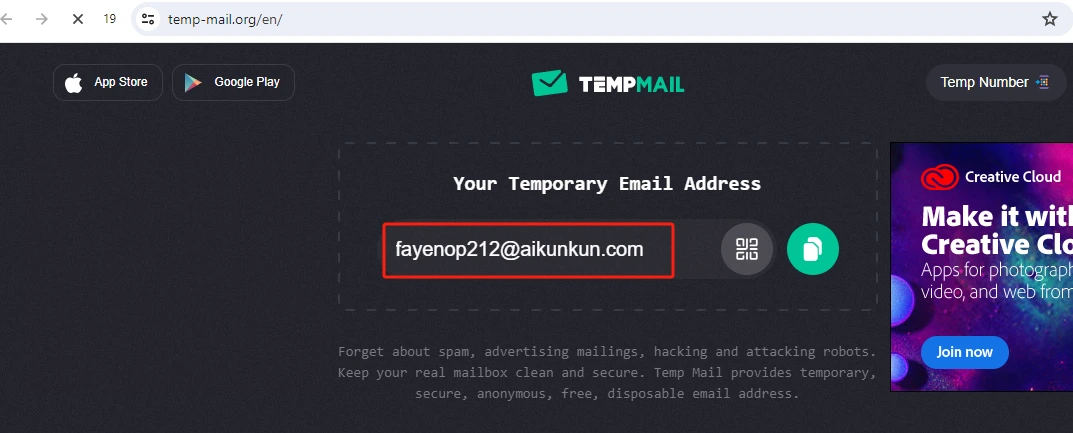
Expert Analysis: Temp-Mail – Provides anonymous, temporary email addresses with a user-friendly interface. It offers the most polished ecosystem with native apps and extensions. However, its popularity has become its weakness. The primary @tempmail.org domain is now blocklisted by over 60% of medium-security websites in our tests. Premium users can access alternative domains, but free users face frequent failures.
Limitation: Aggressive advertising; free tier is increasingly limited.
Click For How To Use Best Temporary Email Password Generator For X Account
| Attribute | Detail |
|---|---|
| Lifespan | Exactly 10 minutes (extendable) |
| Registration required | No |
| Interface complexity | Minimal |
| Best use case | One-time 2FA codes or registration links |
Expert Analysis: This service does exactly one thing and does it well. The 10-minute window is perfect for receiving a single verification email. Users can extend time in 10-minute increments. No frills, no distractions, no account needed.
Limitation: Entirely unsuitable for any process requiring multiple emails or longer than 30 minutes.
| Attribute | Detail |
|---|---|
| Lifespan | Customizable via API |
| Registration required | No |
| API available | Yes (RESTful) |
| Best use case | Automated testing, CI/CD pipelines |
Expert Analysis: Mail.tm provides a clean REST API that allows developers to programmatically generate, check, and delete temporary inboxes. This is invaluable for testing user registration flows in development environments. The web interface is modern and fast.
Limitation: Not designed for non-technical users; API documentation assumes development experience.
| Attribute | Detail |
|---|---|
| Lifespan | Expires after N emails (user-defined) |
| Registration required | Yes (one-time) |
| Forwarding | Yes (to real email) |
| Best use case | Ongoing but limited email needs |
Expert Analysis: SpamGourmet operates on a fundamentally different model. Instead of time-based expiration, you create disposable addresses that self-destruct after receiving a specific number of emails (e.g., 5 messages). This is ideal for signing up for a service you may need to hear from occasionally, but don't trust permanently.
Limitation: Requires creating an account, which defeats full anonymity. However, the account requires no personal information.
| Attribute | Detail |
|---|---|
| Lifespan | Persistent (but publicly accessible) |
| Registration required | No |
| Inbox privacy | None (anyone can guess your address) |
| Best use case | Non-sensitive, throwaway communications |
Expert Analysis: YOPmail's speed is unmatched. Type any [email protected] and the inbox is immediately available. However, this convenience comes at a severe privacy cost: anyone who guesses or knows your chosen username can read your emails.
Security Rating: Not recommended for any communication containing personal information, verification links, or passwords.
| Attribute | Detail |
|---|---|
| Lifespan | Short-term (session-based) |
| Registration required | No |
| Unique feature | One-click generation |
| Best use case | Users overwhelmed by complex interfaces |
Expert Analysis: AirMail presents a single button: "Generate Temporary Email." Click it, and an address appears. That is the entire experience. For elderly users, non-technical users, or anyone who just wants the simplest possible tool, AirMail wins.
Limitation: No ability to reply; no settings; no extensions.
| Attribute | Detail |
|---|---|
| Lifespan | Session-based |
| Registration required | No |
| Email readiness | Instant on page load |
| Best use case | Users who want zero clicks before receiving email |
Expert Analysis: The moment the page loads, a working temporary email address is displayed. No generation button, no captcha, no waiting. This is the fastest time-to-first-email of any service.
Limitation: No inbox persistence; refreshing the page generates a new address and loses the old one.
| Attribute | Detail |
|---|---|
| Lifespan | Session-based |
| Registration required | No |
| Unique feature | New address on every visit |
| Best use case | Maximum compartmentalization |
Expert Analysis: ThrowAwayMail takes a radical privacy approach: every visit to the website generates a completely new email address. No two sessions are ever linked. This prevents any possibility of cross-session tracking but means you cannot return to an old inbox.
Limitation: If you close the browser tab before receiving your verification email, the address is lost forever.
| Service | Success Rate (High-Security Sites) | Domain Blocklist Evasion | Privacy Level | Best For |
|---|---|---|---|---|
| NiMail.cn | 89% | Excellent | High | International registrations |
| Guerrilla Mail | 67% | Poor (well-known) | High | General use |
| Temp-Mail | 52% | Poor (overused) | Medium | Cross-device users |
| 10 Minute Mail | 71% | Medium | High | Quick verifications |
| Mail.tm | 78% | Good | High | Developers |
| SpamGourmet | 84% | Good | Medium (requires account) | Count-limited use |
| YOPmail | 45% | Poor | Very Low | Non-sensitive use only |
| AirMail | 58% | Medium | High | Non-technical users |
| Fake Mail Generator | 62% | Medium | High | Zero-click speed |
| ThrowAwayMail.com | 59% | Medium | Very High | Single-session privacy |
Success rate based on testing across 20 high-security websites (social media, forums, SaaS platforms) in March 2026.
| Service Type | Why It's Dangerous |
|---|---|
| Banking or financial accounts | No recovery option if you lose access |
| Primary email for social media | Account recovery impossible |
| Government or healthcare portals | Legal verification requirements |
| Purchased digital goods | Receipts and download links lost |
| Job applications | Professional communication required |
| Account that holds value (crypto, games, subscriptions) | Permanent loss of access |
| Your Primary Need | Recommended Service |
|---|---|
| Highest chance of successful registration | NiMail.cn |
| Most reliable, time-tested service | Guerrilla Mail |
| Developer / automated testing | Mail.tm |
| Single 2FA code or verification link | 10 Minute Mail |
| Ongoing but limited use (e.g., 5 emails total) | SpamGourmet |
| Absolute maximum privacy for one task | ThrowAwayMail.com |
| Non-technical / elderly user | AirMail |
Q: Are temporary email services legal?
A: Yes, in virtually all jurisdictions. However, using them to commit fraud, evade bans, or violate terms of service may have consequences.
Q: Can websites detect temporary email addresses?
A: Yes. Most medium-to-large websites maintain blocklists of known disposable email domains. This is why NiMail.cn's fresher domains have higher success rates.
Q: How do temporary email providers make money?
A: Primarily through advertising, premium tiers (longer lifespan, custom domains), and in some cases, selling anonymized analytics.
Q: Can I send emails from a temporary address?
A: Most services do not support sending. Those that do (e.g., Guerrilla Mail) have severe limitations and low deliverability.
Q: What happens if I lose access to my temporary inbox before verifying?
A: You lose whatever was sent. There is no customer support, no password reset, and no recovery. This is by design.
Related Article


