Tired of getting blocked by shared proxies? Here's what dedicated proxies actually do, when they're worth the money, and when you should stick with shared.
If you've spent any time looking into proxies—whether for scraping data, running social media bots, or just keeping your online activity private—you've probably run into the term "dedicated proxy." Maybe you've also seen "shared," "static," and "residential" thrown around, and honestly, it gets confusing fast.
Let's clear that up.
I've worked with proxies for years across different projects, from e-commerce monitoring to multi-account management. And what I've learned is this: dedicated proxies are powerful, but they're not always the right answer. Here's what they actually do, where they shine, and when you're better off saving your money.
A dedicated proxy is simply an IP address that belongs to you and only you. Nobody else uses it. No sharing, no crowding, no surprises.
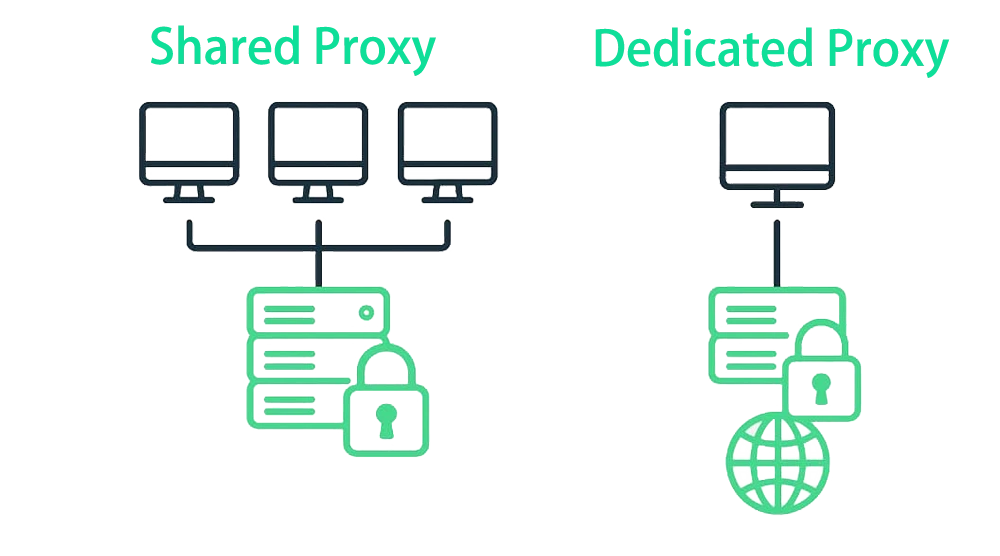
Think of it like this: a shared proxy is a public library computer. Anyone can sit down, browse whatever they want, and maybe do something that gets that machine banned from certain websites. A dedicated proxy is your personal laptop at home. You control what happens on it, and its reputation is entirely up to you.
When you send a request through a dedicated proxy, the website sees that private IP instead of your real one. And because you're the only user, your connection stays fast and your IP stays clean—unless you do something to mess it up yourself.
Let's walk through a real example.
Say you're managing three different Instagram accounts for a small business. You set up each account to use its own dedicated proxy. Now, when Account #1 logs in, Instagram sees a consistent IP address from a specific location. No weird jumps. No sudden changes. Just a normal user behaving normally.
Here's what happens behind the scenes:
The whole thing takes milliseconds. And because the IP never changes, Instagram learns to trust it over time. That's the magic of dedicated proxies.
Not all dedicated proxies come from the same place. Where the IP originates matters a lot.
Datacenter dedicated proxies come from huge server farms. They're fast—really fast. They have enterprise-level bandwidth and processing power. But they're also easier to detect as proxies because they come from known datacenter addresses. If a website really wants to block datacenter traffic, it can. That said, for many tasks like price monitoring or SEO tracking, they work beautifully and cost much less.
Residential dedicated proxies are trickier. True residential IPs come from real home devices, but those are rarely dedicated to a single user. So when people talk about "dedicated residential proxies," they usually mean static ISP proxies. These are IPs that ISPs assign to datacenter facilities. They look like real home addresses but perform like datacenter proxies. They're excellent for hard-to-scrape sites, but you'll pay a premium for them.
After using both shared and dedicated proxies for years, here's where dedicated ones really win.
Speed and stability. Since you're not sharing bandwidth with strangers—some of whom might be torrenting or running heavy scripts—your connection stays consistent. You get full access to the proxy's resources. This matters when every second counts, like checking out during a limited sneaker release.
A clean reputation. This is huge. With shared proxies, you never know what the other users are doing. One person spams a forum, and suddenly that IP is blacklisted everywhere—including on the sites you need. With a dedicated proxy, your IP's reputation is entirely in your hands. If you follow the rules, it stays trusted.
No surprise blocks. Because you're the only user, you won't wake up to find your IP banned because someone else abused it. That peace of mind alone is worth the extra cost for many businesses.
Long, stable sessions. Some tasks require staying logged into a site for hours or days. A dedicated proxy keeps that session alive without rotating to a different IP midway through. Social media managers love this because platforms flag frequent IP changes as suspicious.
I also need to be honest about where dedicated proxies fall short.
They cost more. No way around it. You're paying for exclusivity, and providers charge accordingly. If you need hundreds of IPs, that adds up fast. Shared proxies are dramatically cheaper because costs are split across many users.
Limited IP pool. If you buy 10 dedicated proxies, you get 10 IPs. That's it. With a shared rotating pool, you might have access to millions. For massive scraping operations that require constantly switching IPs, dedicated proxies can feel restrictive.
Fewer locations. Want dedicated IPs in twenty different cities? You need to buy twenty separate proxies. Shared plans often give you access to dozens or hundreds of locations for one flat fee.
More work to manage. With shared or rotating proxies, the provider usually handles IP health checks and rotation. With dedicated proxies, that's on you. You need to monitor for blocks, replace faulty IPs, and handle your own rotation strategy if needed.
These terms get mixed up constantly. Here's the simple truth.
A shared proxy is used by many people at once. Cheap, but unreliable. You're at the mercy of strangers.
A dedicated proxy is yours alone. Fast, clean, and more expensive.
A static proxy means the IP never changes. It's not rotated. A static IP can be either shared or dedicated.
The best setup for most serious work is a static dedicated proxy — an IP that never changes and belongs only to you. That's what gives you the trust and consistency that platforms like Instagram, Amazon, and Ticketmaster respond well to.
Based on real-world experience, here's where dedicated proxies are worth every penny.
Managing multiple social media accounts. Each account gets its own dedicated proxy. Platforms see consistent login locations and behaviors, which dramatically reduces bans and login challenges.
Scraping sites with strong anti-bot defenses. E-commerce sites, travel aggregators, and sneaker stores actively fight scrapers. A clean, dedicated residential proxy (static ISP) often works when shared proxies get blocked immediately.
Ad verification. You need to see exactly how your ads look in different regions. A shared proxy with a bad reputation might show you a completely different experience. Dedicated proxies give you an honest view.
Account creation. Mass-creating accounts on platforms like TikTok or Twitter requires clean, distinct IPs. Dedicated proxies prevent the "this IP has been used too many times" problem.
Long-term access to geo-restricted content. If you want stable access to a streaming service from another country, a dedicated proxy provides a reliable connection that doesn't drop or rotate.
On the flip side, don't buy dedicated proxies if:
For those cases, shared or rotating proxies are fine. They're cheaper and give you more IPs to work with.
A dedicated proxy is a premium tool for serious work. It gives you speed, control, and a clean reputation that shared proxies can't match. But that power comes with a higher price tag and more responsibility on your end.
If you're running a business where reliability directly affects your bottom line—whether that's social media marketing, e-commerce automation, or data collection—dedicated proxies are worth the investment. They're not magic, but they remove a lot of the headaches that come from sharing IPs with strangers.
If you're just getting started or working on a shoestring budget, start with shared or rotating proxies. Learn the ropes. Then upgrade when you feel the pain of getting blocked at the worst possible moment.
Because eventually, if you do this work long enough, you will feel that pain. And that's when you'll understand exactly why dedicated proxies exist.


